
Parentification Trauma: Why Parentified Adults Can’t Rest
Someone offers to help, and your first feeling is a small, polite panic. You already have it handled. You had it handled at nine years old, when you could read your father’s mood from the way the front door closed, and at twelve, when you forged your mother’s signature on your own permission slips because you knew she was overwhelmed and asking would have put one more thing on her plate. Now you rehearse "I'm a little tired, I could use a break" all afternoon before coming home to your partner. Then you chicken out and say something else.
A honeybee colony is organized by scent. While the queen is alive and laying eggs, her pheromones and the scent of her young brood keep every worker's ovaries dormant, and the workers spend their lives foraging and feeding larvae. When the queen is lost and the last of her young brood has grown up, some of those workers start laying eggs themselves. Beekeepers call them laying workers. They are doing a queen's job in a worker's body, and they keep the colony going for a while at a steep price: their eggs are unfertilized and hatch only into drones, so the hive grows more and more unbalanced over time. A colony that has become stuck in this unbalanced arrangement will often refuse a new queen when a beekeeper introduces one.

Parentification trauma follows that same pattern. A parentified child steps into an adult role the family left empty, and the household survives, albeit in an increasingly unbalanced way. As an adult, that child then finds themselves strangely stuck, unable to relax even on vacation and unable to accept help from even the most trustworthy people in their life, despite their own better judgment that sees the mounting costs of their compulsive over-performance.
What Is Parentification Trauma?
Parentification trauma is the lasting effect of taking on a parent's role as a child. The role can be practical, like raising younger siblings or managing the household money, or emotional, like serving as a parent's confidant and peacekeeper. Researchers call these instrumental and emotional parentification, and many people lived with both.
It is more common than most parentified children assume. Estimates range from a few percent of young people to more than 30%, depending on the population and how it is measured, and a review of 95 studies found it in families on six continents. The same review found that the earlier it starts and the longer it lasts, the heavier the toll it takes on the child, which increases the risk for long-term consequences when that child grows up.
If you grew up assuming your family was uniquely unable to take care of themselves and you were uniquely responsible for holding it together, the numbers tell a different story. Some children stepped up because a parent was depressed or chronically ill, or because a divorce left one exhausted adult doing the work of two. Others were the children of immigrants and became the family's translator for a new country, reading lease agreements in elementary school. In every version an adult role was empty, and a child filled it.
A laying worker is an ordinary worker bee answering an emergency. Her colony lost its queen, the comforting scent that told her someone else had things under control slowly faded, and she did what the hive needed. Nothing about her was defective before the loss, or after. The same was true for you.
One client came into a therapy session extremely angry at her friend who had just told her that she had been “exploited” as a child, which she found to be deeply insulting to her loving and supportive parents. I asked her what sorts of childhood experiences her friend was referring to, and my client told me that she was the oldest of 12 children, and had been helping her mother raise all of her siblings since she was able to walk. She had recently started physical therapy for chronic pain caused by her joints compensating for spending her entire childhood continuously holding an infant on her left hip while using her right hand to do schoolwork. But, she pointed out, this was how her extended family and their community had operated for generations, she had received so much praise and appreciation for being such a dutiful daughter and sister, and it was very difficult to acknowledge both how much love she felt for her parents and siblings, and also how profoundly she had been psychologically and physically harmed by taking on that parent-like role at such a young age.
Parentified Child as Adults: What Are the Signs?
Adults who were parentified as children often exhibit a predictable cluster of traits: feverish work ethic, avoidance of delegating or asking for help, close attention to other people's moods, and guilt when resting. Many of them assume these traits are simply their natural personality.
Many parentified children grow up and make caregiving their career. In one study, psychology students planning clinical careers reported more parentification in their mid-teens than either psychology students with no clinical plans or business students. The skills transfer beautifully. The exhaustion transfers too.
The costs of parentification are subtle and cumulative, so often they are not noticed until an adult starts displaying mental health symptoms, seemingly out of nowhere. A meta-analysis pooling 12 studies and nearly 2,500 adults found that people who were parentified in childhood carry a higher risk of mental health problems as adults. The insomnia, the irritability, the crushing feeling of never-ending pressure, the inability to “just be in the moment” and be emotionally present with loved ones in moments of relaxation, all have a history even when it started so young that the person can’t remember being any other way.
An ordinary worker bee and a laying worker both start out the same. Workers only start laying eggs when they sense that the colony lacks a queen. They become whatever the colony needs: change the conditions, and you change the bee. The traits you think of as your core personality developed so that you could be what your family needed in the specific conditions of your childhood. That is good news, because conditions can change, and so can people.
Why Parentified Adults Struggle to Accept Help
Parentified adults struggle to accept help because the part of their personality that took over and kept them safe in childhood learned that relying on anyone else was dangerous. To that part, accepting any offer of help, including therapy, can feel like a threat to the dependable, undemanding, self-sacrificing persona that they worked so hard to cultivate.
Most parentified children were praised for the role. Teachers and relatives called you "so mature for your age," and the compliment landed as proof that you were doing the right thing. Laying-worker colonies have a version of this. Other workers sometimes gather around one laying worker and tend her the way they would tend a queen, and beekeepers describe these colonies as acting as though the job were already filled. That is why they often become attached to this way of doing things and reject a new queen when one becomes available.

In IFS (Internal Family Systems) therapy, the part of you that stepped into the parentified role is called a protector. Protectors take on their jobs because the consequences of not doing so would be catastrophic, and they keep doing them long after the original emergency has passed, because nobody ever relieved them of duty. Behind the protector there is usually a younger part carrying the accumulating cost of that life-saving over-performance: the loneliness of being the one who was never taken care of, a child who could never just be a child and trust their parents to keep them safe. IFS calls this part an exile.
A lot of high-performing people stay out of therapy because of one fear: that healing their childhood trauma would cost them what makes them good at their jobs and good for the people who depend on them. Research on parentification has started to look at its upside as well as its costs, and one study of adults parentified as children examined the posttraumatic growth that can follow it, finding resilience to be the strongest predictor of that growth. In IFS, successful therapy means that every part stays. A protector that learns to relax and rely on others when it’s safe to do so still keeps every skill it learned along the way. Being “the one who can handle anything” becomes an optional resource instead of a prison.
When a colony gets a queen again, its workers stay. They stop laying eggs and go back to foraging and raising larvae, the work their bodies are built for, and they are still very good at it.
How Therapy Helps Parentification Trauma
Therapy for parentification trauma helps a person access their entire Self, which includes so much more than the overly responsible role they took on as a child. Therapy allows their caretaking and overfunctioning behaviors to become tools they can pick up when they want to, and set down when they don't, without fear or guilt. The ability to stay confident in who they are, apart from the role, is a state IFS calls Self-leadership.
Many kinds of trauma therapy help people recover from parentification trauma. Parentification can expose children to complex trauma, the kind of long-term, sustained relational dysfunction that tends to produce complex PTSD (C-PTSD). A 2025 meta-analysis of randomized trials found that psychotherapy produced large reductions in PTSD and depression symptoms among adults exposed to complex trauma, and those gains largely held at follow-up. The research base for IFS specifically is still growing, and early results are promising: in a pilot study of adults with PTSD after multiple childhood traumas, 92% no longer met criteria for PTSD one month after 16 sessions of IFS. That study was small (17 people) and had no comparison group, so it’s an early signal. In addition to helping people recover from the symptoms of their childhood trauma, IFS is particularly well-suited to answering the question, “If I can’t always be the one people depend on, who am I?”
Beekeepers have learned that dropping an outside queen into a laying-worker colony often fails. The colony can bring itself back into balance, with just a little outside help. The beekeeper adds a frame of young brood from a healthy hive, and its scent starts relaxing the laying workers. After a second or third frame, the laying workers relax enough that the colony can begin raising a queen of its own, choosing the larvae and feeding them into queens itself. The beekeeper creates the right conditions. The colony finds its own queen.
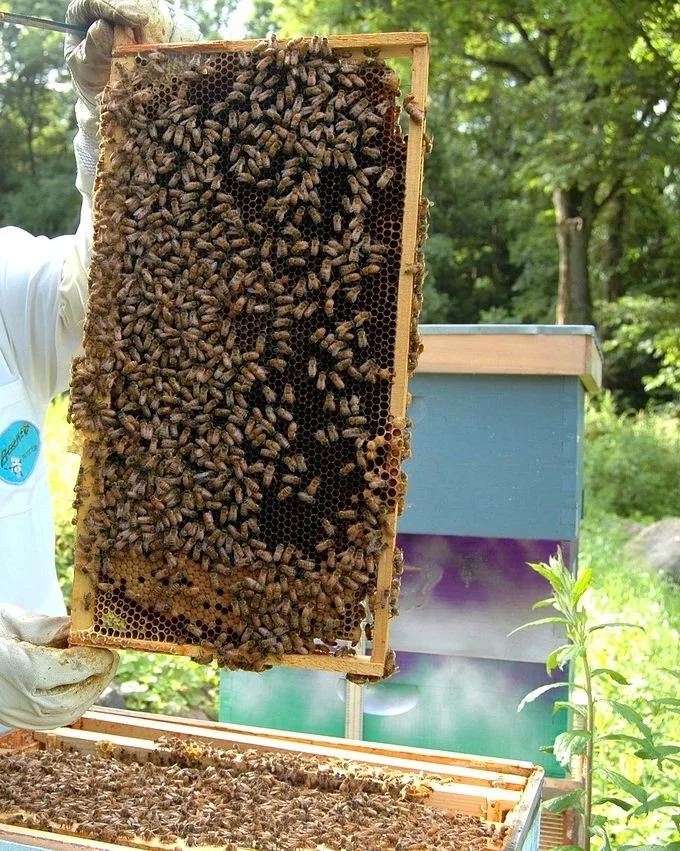
In this work, the therapist is the beekeeper, and the new queen is your Self. IFS holds that everyone has a Self: a dynamic and curious untraumatized center that stays intact underneath the parts that take on rigid roles to survive adverse conditions. Therapy can provide the right conditions for those protective parts to recognize that you’re an actual adult now, not a child trying desperately to do an adult’s job. Then they can finally relax and allow your Self to grow into who you really are.
What IFS Therapy for Parentification Looks Like
IFS therapy for parentification trauma works through a series of internal conversations with the parentified part of you, learning why its behaviors were necessary when you were young and what it fears would happen if it ever stopped. Once the protective part trusts that you (the adult, grounded version of you) respect its work and can handle what it has been holding, it will let you heal the exile it has been protecting: a part of you that still carries all the loneliness and pain of being the child who never had a turn to be cared for.
The first shift is usually small. Instead of fully believing that you need to handle everything, you start to notice the part of you that feels that way, and remember why, and that half-step of distance is where Self starts to show up. IFS calls this unblending. Later, once the exile has been heard and cared for by you, it can let go of the beliefs it picked up back then, such as the idea that its needs are too much and it must hide them from everyone else. IFS calls that unburdening. When the younger part has let go of its burdens, the protector can stop keeping watch. It gets to choose a new role, and it usually chooses one that uses its skills only when needed, without the constant vigilance.
One of my clients came into therapy because she felt isolated and unloveable. She recognized that she needed to be vulnerable and authentic with her friends in order to form close relationships, but whenever she tried to do it, she would be overwhelmed with guilt and fear. Using the IFS approach, she learned about her guilty and fearful parts, and discovered that they had originated when she was a child and her mother had been hospitalized for suicidal ideation. She thought that the stress of taking care of children had pushed her mother over the edge, and from then on her guilty and fearful parts had carefully prevented her from ever showing her own difficult emotions or needs, in an attempt to protect her mother’s mental health. Once she was able to unburden these parts and the exiles they protected, she was finally able to open up to her friends, and receive the love and emotional support that she had wanted for so long.
If the same behaviors that keep you safe are also keeping you stuck, set up a free consultation call.
Parentification Trauma FAQs
Short answers to common questions about parentification and parentified children.
What is parentification?
Parentification is a family pattern in which a child takes on responsibilities that belong to a parent. It can involve practical tasks, such as caring for siblings or managing household finances, or emotional ones, such as serving as a parent's main source of support. It usually develops when a parent is unavailable, physically or emotionally.
What is emotional parentification?
Emotional parentification happens when a child becomes responsible for a parent's feelings. Common examples include acting as a parent's confidant or managing a parent's moods to keep the household calm.
Is parentification considered trauma?
Parentification is described in the research as a family pattern, and it is linked to a higher risk of mental health problems in adulthood, particularly when it started early and lasted a long time. Its effects in adulthood are treatable.
How do you deal with parentification as an adult?
Most adults start by recognizing the pattern and how it shows up now, especially in relationships and in how they rest. Trauma-focused therapy helps address the underlying beliefs and protective habits. In IFS therapy, that means building a relationship with the parts that took on the parent role so they can step back from it.
This post was researched and drafted with the help of AI and personally reviewed, edited, and expanded by Cay — including all client examples and clinical perspectives.
Written by Cay Schubert